
The information contained within does not constitute financial, legal, or tax advice, and does not represent a view or position held by CORALA. It is a summary of publicly reported data and commentary for general information only. Reach out to a qualified mortgage broker, financial advisor or tax professional to discuss your specific circumstances before making any decisions.
Cotality's Home Value Index (HVI) for October 2026, released on Thursday 1 October, points to a market where conditions may be tilting in favour of buyers. Advertised stock has built up, homes are taking longer to sell, and rental yields have climbed to their highest level in around seven years [1].
For Australian expats in the U.S. weighing a purchase back home, these shifts may be worth understanding. They sit alongside a softer price environment and higher interest rates, both of which carry their own risks. CORALA has summarised the key findings below for general awareness only. All dollar figures are in Australian dollars unless stated otherwise.
Are buyers gaining more choice?
Across the combined capitals, total advertised inventory was 23.1% higher than a year earlier, even though the flow of new listings was 9.2% lower [1]. Stock has accumulated because homes are selling more slowly than new ones are coming to market. Capital city homes took a median of 39 days to sell, compared with 23 days a year ago [1].
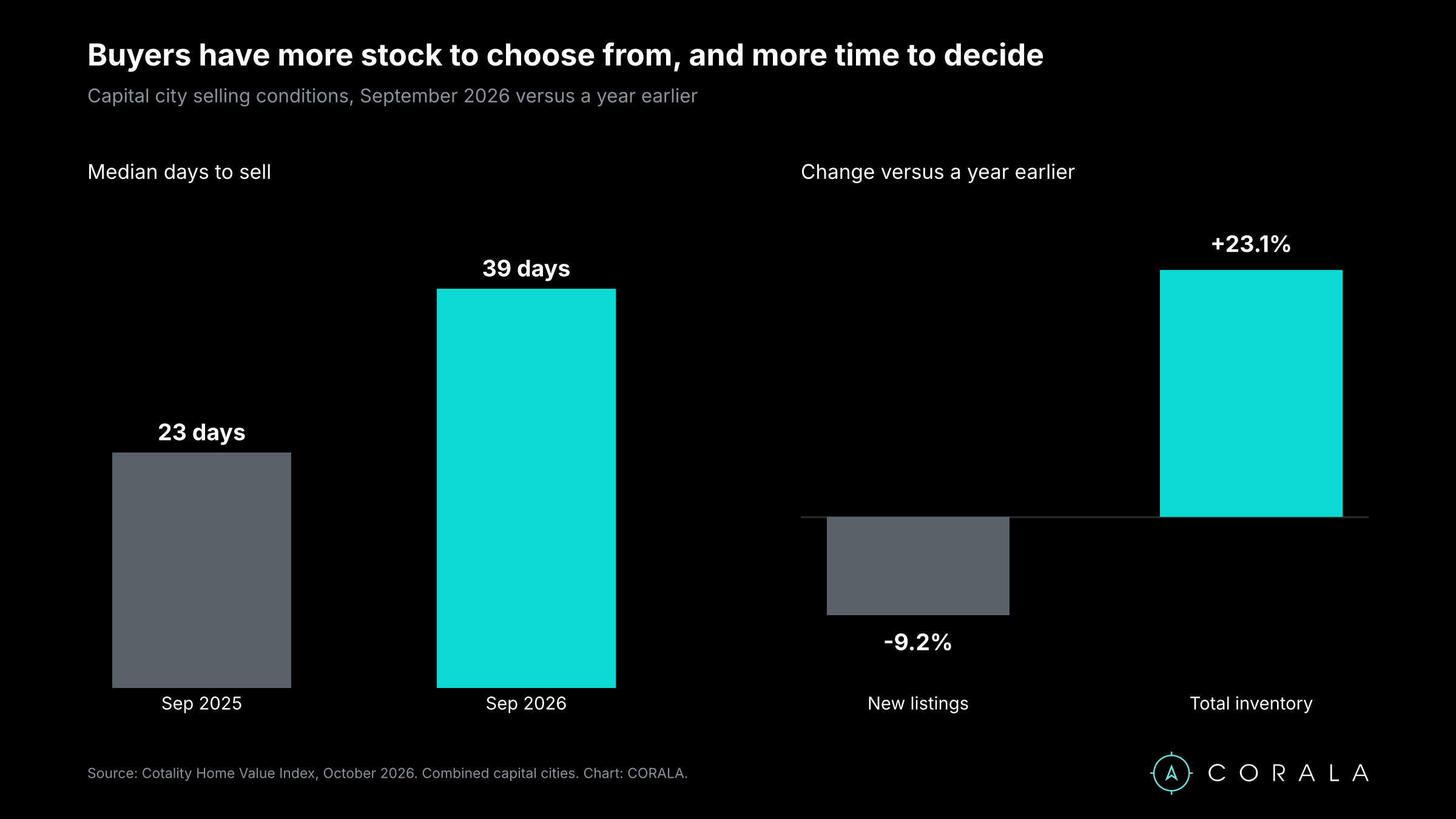
Across the combined capitals, fewer new listings are coming to market, yet total inventory is 23.1% higher than a year ago as homes take longer to sell. Source: Cotality Home Value Index, October 2026.
Turnover has also eased considerably. Cotality estimated home sales over the past three months were 19.1% lower than a year earlier nationally and 13.3% below the previous five-year average [1]. The sharpest annual falls in sales volumes were in Brisbane (down 27.2%), Sydney (down 26.5%) and Perth (down 24.2%) [1].
Cotality observed that buyers generally have more choice, less urgency and greater scope to negotiate, while vendors may need to become more realistic about price expectations [1]. It also noted that auction clearance rates have held below average across many markets [1]. However, Cotality's research director, Tim Lawless, pointed out that many prospective buyers may currently lack the confidence or financial capacity to take advantage of these conditions [1]. For buyers who are in a position to act, this may mean less competition than in recent years.
What has happened to values?
National dwelling values fell 1.1% in September, the sixth consecutive monthly decline, leaving values 5.2% below their March 2026 record high [1]. The decline was broad: every capital city except Darwin recorded a fall, and 71% of regional Statistical Area Level 3 (SA3) markets, the Australian Bureau of Statistics (ABS) geography Cotality uses to report sub-markets, also declined over the month [1]. Cotality noted that 97% of capital city suburbs were down in value over the three months to the end of September [1].
Brisbane recorded the sharpest monthly fall among the capitals at 1.5%, slightly ahead of Sydney at 1.4% [1]. Sydney values are now 8.6% below their February peak, a slightly deeper fall than at the equivalent stage of the 2022 to 2023 downturn [1]. Melbourne's monthly decline was milder at 0.7%, with values 7.2% below their November 2025 cyclical high [1].
Over the full year, the national result was flat at 0.0%, but this average conceals wide variation [1]:
Darwin recorded the strongest annual gain at 11.9%, followed by Perth at 10.1%.
Sydney (down 7.0%) and Melbourne (down 6.2%) are well into negative annual territory, while Canberra is down a more modest 1.6%.
Combined regional values rose 5.6% over the year, compared with a 1.8% decline across the combined capitals.
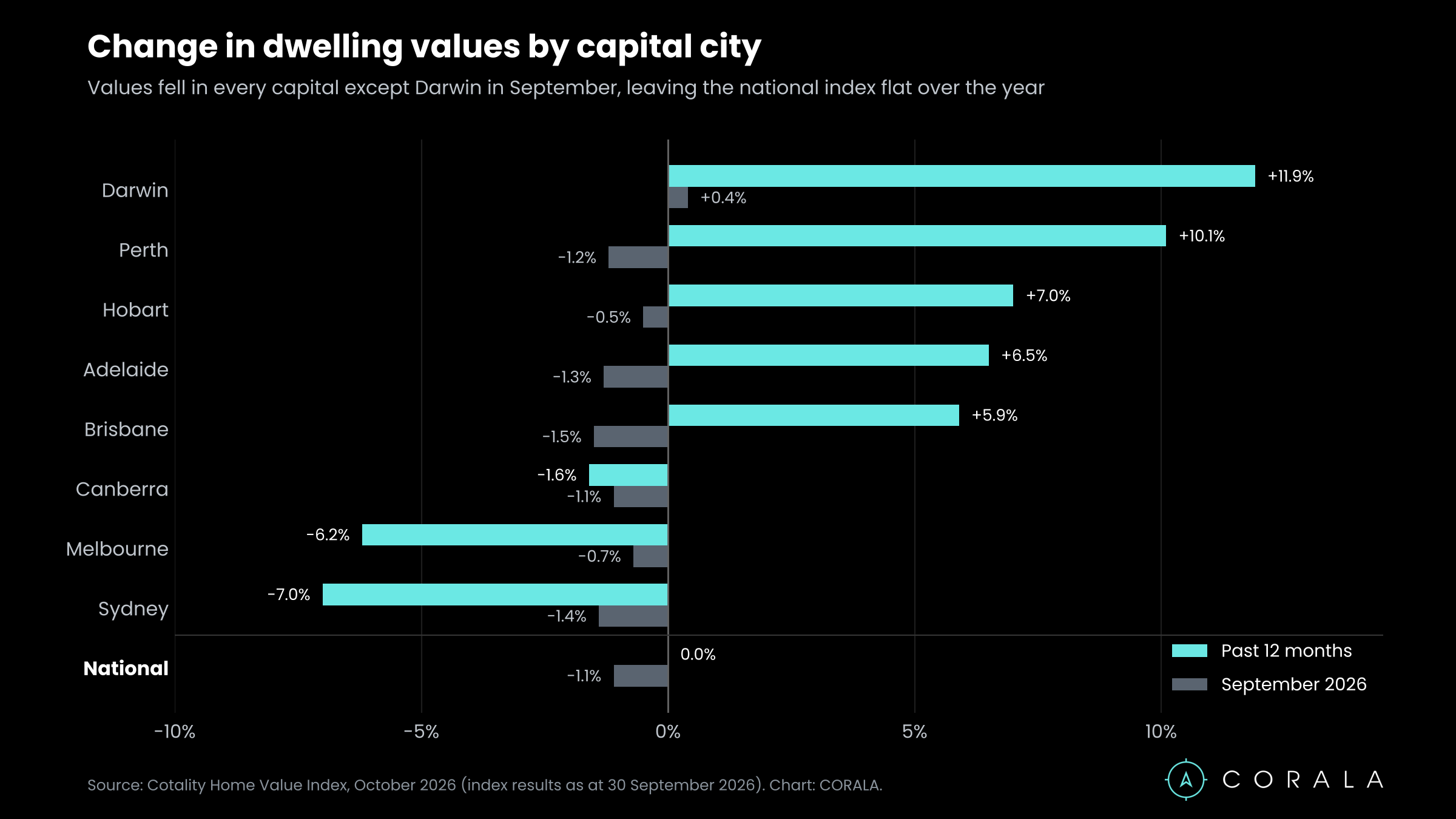
Values fell across every capital except Darwin in September, while annual results range from a 7.0% fall in Sydney to an 11.9% rise in Darwin. Source: Cotality Home Value Index, October 2026.
Property type may also matter. In Sydney, house values fell 8.2% over the year while unit values fell 3.8%, and Melbourne showed a similar pattern, with houses down 7.3% and units down 3.8% [1]. At the end of September, Cotality's median dwelling value was $899,236 nationally, $1,198,596 in Sydney and $975,022 in Perth [1].
Cotality also revised its August result, with national values now estimated to have fallen 1.2% that month rather than the 0.9% initially reported [1]. Revisions are a normal part of index updates, but they suggest early estimates in a downturn may understate the pace of decline.
Why are rental yields rising?
With rents still growing and values falling, gross rental yields have lifted to 3.85% nationally, the highest since August 2019 [1]. Across the capitals, yields range from 3.4% in Sydney to 6.5% in Darwin, and units generally show higher gross yields than houses (4.7% versus 3.6% nationally) [1]. Cotality suggested yields may rise further if rents keep pushing higher while values trend lower [1].
The rental market itself is easing from very tight levels. The national vacancy rate rose to 2.0% in September, up from a record low of 1.5% in February 2026, but still well below the pre-COVID decade average of 3.3% [1]. Hobart had the highest capital city vacancy rate at 3.0%, while Adelaide remained the tightest at 1.4% [1]. Monthly rental growth slowed to 0.3% in seasonally adjusted terms, the smallest monthly rise since May 2025, taking annual rental growth to 5.5% [1].
Higher gross yields do not necessarily translate into positive cash flow. Cotality cautioned that opportunities for neutral or positive cash flow remain limited once holding costs such as interest, insurance, maintenance and strata fees are taken into account [1].
What factors may shape the months ahead?
Cotality expects conditions to remain under downward pressure in the near term, pointing to several headwinds [1]:
The Reserve Bank of Australia's (RBA) September rate rise, which took the cash rate to its highest level in around fifteen years, may reduce borrowing capacity and add to repayment pressure. Cotality also flagged the possibility of a further increase in November. Our earlier article on the RBA's September decision covers this in more detail [2].
Affordability remains stretched relative to household incomes, and deposit requirements continue to be a substantial hurdle.
Consumer confidence remains weak, which has historically been associated with lower housing turnover.
Changes to negative gearing and capital gains tax (CGT) settings announced in the Federal Budget have coincided with a sharp fall in investor demand. Our earlier article on the 2026 CGT changes discusses how these may affect Australians living overseas [3].
Cotality also identified factors that may help limit the decline: a labour market that remains reasonably tight, and persistently low levels of new housing supply, constrained by high construction costs and challenging project economics [1]. Its overall assessment was that a gradual drift lower in values appears more likely than a sharp correction, with outcomes continuing to vary significantly between regions, price points and buyer segments [1]. Forecasts can and do change as new data arrives.
Conditions like these may give some buyers more room to negotiate, but they also carry the risk of further price falls after purchase. How this plays out may differ significantly between cities, suburbs and property types.
For expat buyers: questions worth raising with a broker or advisor
Market-wide averages may say little about any individual suburb or property. Expats may consider raising questions like the following with an expat-specialist mortgage broker, financial advisor or tax professional, rather than drawing conclusions from headlines alone:
With more stock on the market and homes taking longer to sell, how might negotiating conditions differ in my target area, and how should I weigh that against the risk of further price falls?
How might rising rates, and potentially further increases, affect my borrowing capacity with lenders that accept foreign income?
If I am buying for rental income, what might my actual cash flow look like once interest, insurance, strata and maintenance are included, rather than relying on gross yield alone?
How might the Federal Budget changes to negative gearing and CGT apply to my circumstances as a non-resident or temporary resident?
Are there differences between houses and units, or between capital city and regional markets, that are relevant to my goals and time horizon?
A note on this summary
This post is intended purely as a summary of publicly available data and commentary on housing market conditions, which may change quickly. CORALA does not offer financial, credit or tax advice and does not hold a view on the future direction of property values or interest rates. Anyone considering a purchase, or holding Australian property, should speak with a qualified mortgage broker, financial advisor or tax professional about their own circumstances before making any decisions. CORALA's Home Ground Advantage network includes mortgage brokers experienced in lending to Australian expats.
Contact us today for a discussion about your property investing goals or for an introduction to one of our specialist expat mortgage brokers.
Sources
[1] Cotality, "Home Value Index, October 2026: Australian housing values down for sixth straight month in September", 1 October 2026. https://discover.cotality.com/hubfs/Article-Reports/COTALITY%20HVI%20OCT%202026%20FINAL.pdf
[2] CORALA, "What Might the RBA's September Rate Rise Mean for Aussie Expats Buying Property Back Home?", 2026. [URL to confirm]
[3] CORALA, "Doing a Stint Overseas? Know How the 2026 CGT Changes Affect Your Australian Property", 2026. https://www.corala.io/insights/doing-a-stint-overseas-know-how-the-2026-cgt-changes-affect-your-australian-property