
The information contained within does not constitute financial, legal, or tax advice, and does not represent a view or position held by CORALA. It is a summary of publicly reported data and commentary for general information only. Reach out to a qualified mortgage broker or financial advisor to discuss your specific circumstances before making any decisions.
On Tuesday 29 September, the Reserve Bank of Australia (RBA) lifted the official cash rate by 25 basis points to 4.60%, its fourth increase of 2026 [1]. The earlier rises came in February, March and May, and the cash rate now sits at its highest level in around fifteen years [2][3].
The decision lands in the middle of a broad housing downturn. For Australian expats in the U.S. who own, or are planning to buy, property back home, the combination of higher rates, softer prices and a weaker Australian dollar may affect borrowing capacity, holding costs, and how the market behaves over the coming months.
CORALA has summarised the decision and the latest data below for general awareness only.
What did the RBA decide, and why?
The Monetary Policy Board's decision was unanimous [1]. In its statement, the Board said inflation remains elevated and that some of the upside risks it flagged in August are now materialising. It pointed to the broadening conflict in the Middle East and global energy prices well above what had been assumed in its August forecasts. It said higher fuel prices have partially flowed through to other goods and services, and that recent Australian inflation outcomes came in stronger than expected [1].
The Board acknowledged that its three earlier increases this year have tightened financial conditions and that the economy appears to be slowing. It specifically noted that housing prices have fallen in most capital cities and that new housing loans have declined noticeably [1]. Even so, it judged that further tightening was warranted, and left the door open to more, saying it would continue to act as necessary, "including increasing the cash rate target further if needed." [1]
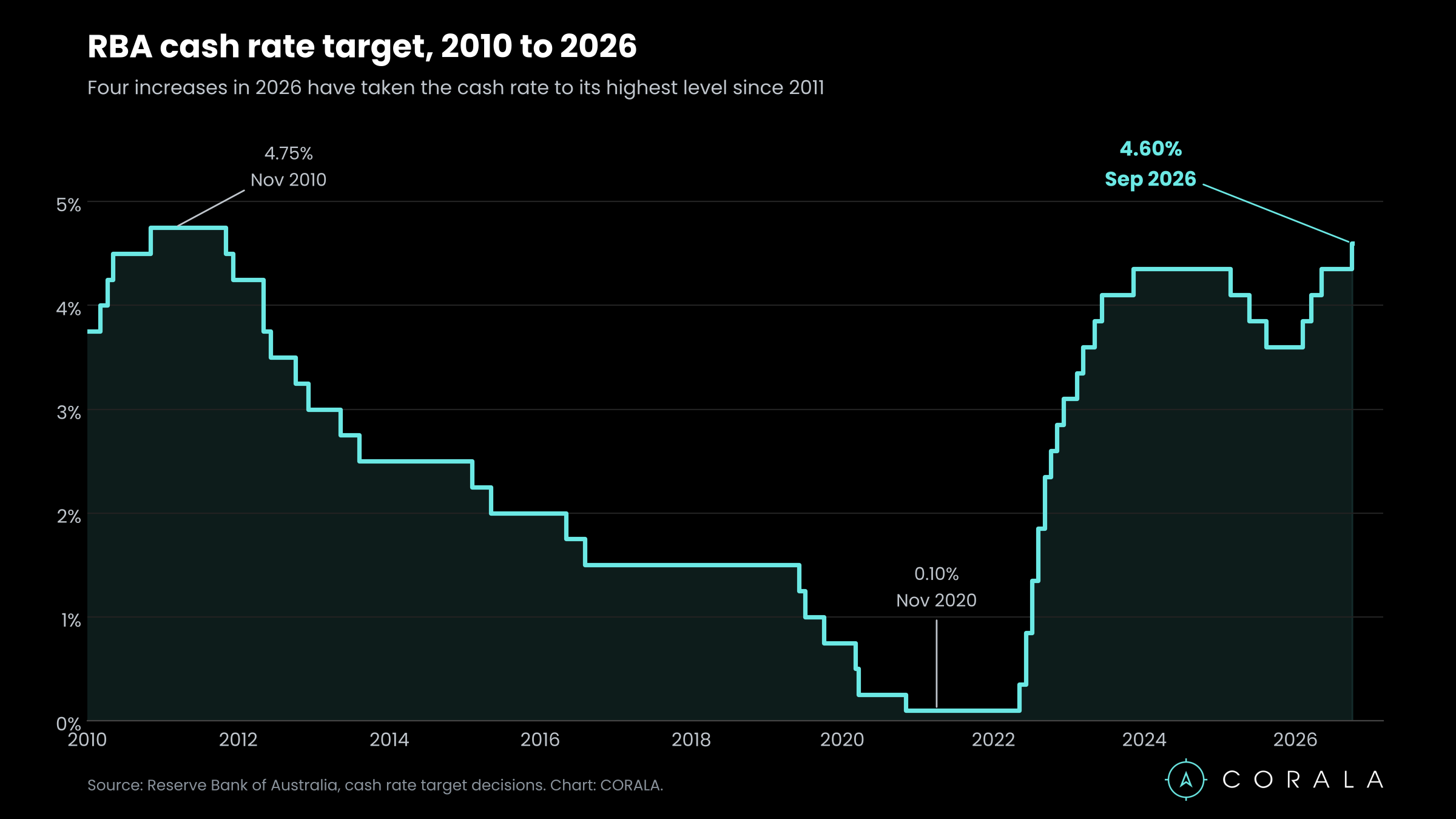
The RBA cash rate target has risen 100 basis points in 2026 to 4.60%, its highest level since 2011. Source: Reserve Bank of Australia.
How has the housing market been tracking?
Cotality's Home Value Index (HVI), released on 1 October, shows national dwelling values fell 1.1% in September. This was the sixth consecutive monthly decline, and it leaves values 5.2% below their March 2026 peak [3]. Every capital city except Darwin recorded a fall, and Cotality reported that 97% of capital city suburbs were down in value over the three months to September [3].
The picture varies considerably by city [3]:
Sydney continues to lead the correction, with values 8.6% below their February peak.
Brisbane recorded the sharpest monthly fall among the capitals, down 1.5% in September.
Perth fell 1.2% in the month and is 6.0% below its April peak, although values remain 10.1% higher over the year.
Melbourne's rate of decline eased to 0.7% for the month.
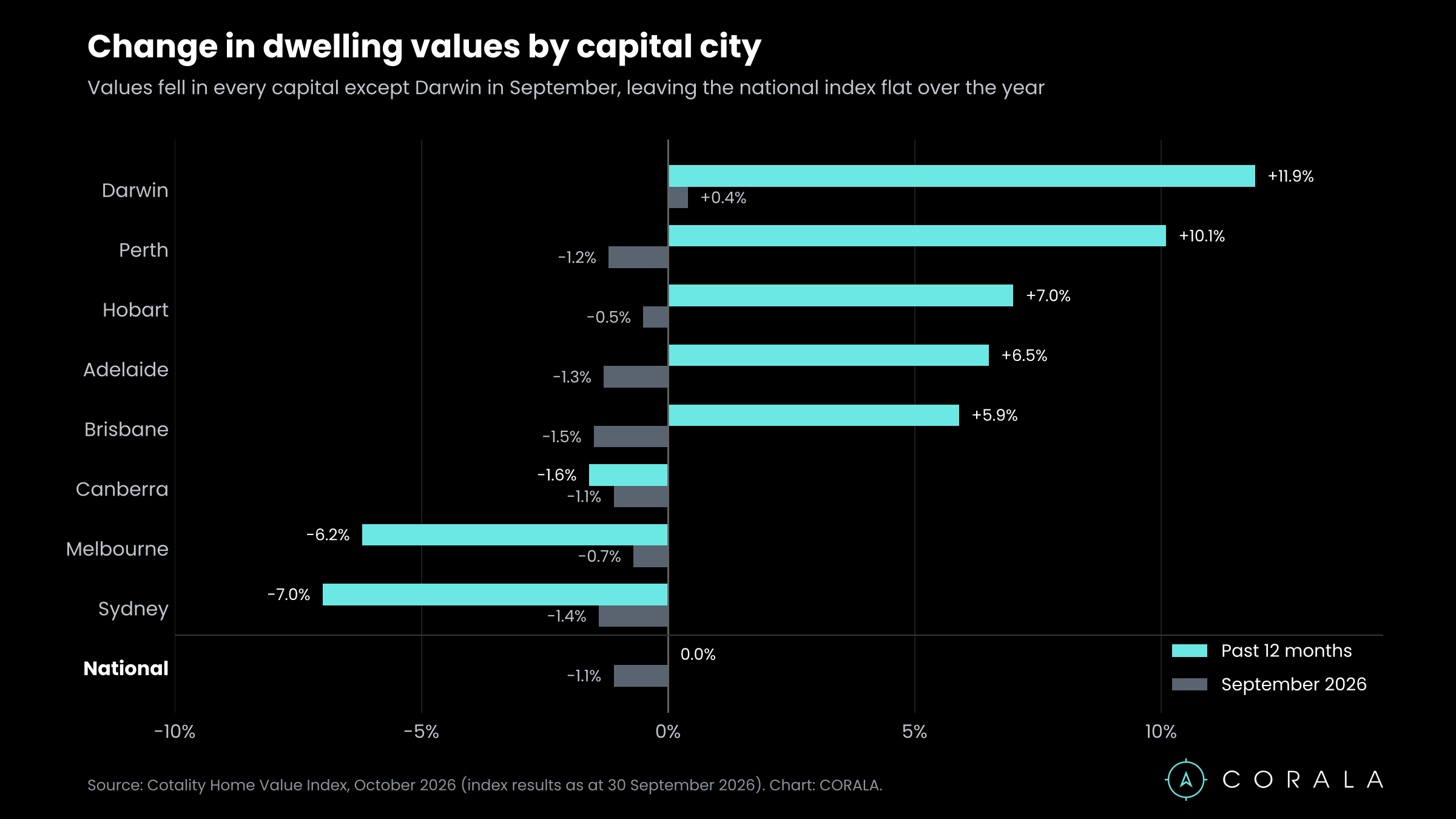
Values fell across every capital except Darwin in September, while annual results range from a 7.0% fall in Sydney to an 11.9% rise in Darwin. Source: Cotality Home Value Index, October 2026.
Activity has slowed alongside prices. Cotality estimated that home sales over the past three months were tracking 19.1% below a year earlier [3]. Total advertised inventory across the combined capitals was 23.1% higher, and capital city homes were taking a median of 39 days to sell, compared with 23 days a year earlier [3]. Cotality also identified the investor tax changes announced in this year's Federal Budget, including the negative gearing and capital gains tax (CGT) changes covered in our earlier articles, as an additional drag on investor demand [3].
Cotality's research director Tim Lawless noted that rising stock may give buyers more choice, but observed that many prospective buyers "don't have the confidence or financial capacity to buy at the moment." [3] Cotality's outlook suggests the most likely path may be a gradual drift lower in values rather than a sharp downturn, with conditions continuing to vary across regions, price points and buyer segments [3].
What about rents and yields?
For investors, the rental side is moving in a different direction. Cotality reported national rents were 5.5% higher over the year, although monthly growth eased to 0.3%. The national vacancy rate rose to 2.0%, its highest since January 2025 [3].
With rents rising and values falling, gross rental yields have lifted to 3.85% nationally, the highest since August 2019. Across the capitals they range from 3.4% in Sydney to 6.5% in Darwin [3]. Cotality cautioned, however, that opportunities for neutral or positive cash flow remain limited once interest, insurance, maintenance and strata costs are factored in [3].
What might it mean for borrowing?
For existing borrowers on variable rates, repayments may rise if lenders pass the increase on in full. As one reported illustration, a borrower with a $731,000 loan on a 6.21% variable rate could see repayments rise by around $113 a month [4]. Fixed rates have also been moving, with Canstar recording 16 lenders lifting at least one fixed rate during September [5].
For prospective buyers, the bigger issue may be borrowing capacity. Lenders typically assess serviceability using a buffer above the actual loan rate, so a higher cash rate may reduce the maximum a lender is prepared to offer. As covered in our earlier articles on expat borrowing capacity, many lenders also apply adjustments to foreign income. The combined effect could therefore be more pronounced for expat borrowers than for local applicants, although this varies by lender and individual circumstances.
The currency angle for U.S.-based expats
For Australians earning in U.S. dollars, the exchange rate matters as much as the cash rate. The Australian dollar fell after the decision rather than rising: it briefly moved toward US$0.703, then reversed to around US$0.698, a two-month low [6]. This followed the U.S. Federal Reserve's first rate increase since 2023, which had strengthened the U.S. dollar [7].
A softer Australian dollar may stretch U.S. dollar savings further when converted for a deposit. However, currency movements can reverse quickly, and lenders may convert and assess foreign income differently. This may be worth discussing with an expat-specialist broker before relying on any particular exchange rate.
What may come next?
The RBA's next meeting runs 2 to 3 November, with the decision announced on 3 November alongside the quarterly Statement on Monetary Policy [8]. September quarter Consumer Price Index (CPI) data from the Australian Bureau of Statistics (ABS), due on 28 October [9], may be an important input. Cotality also noted that the possibility of a further rise in November is weighing on household confidence [3].
Views among the major banks differ. CBA has described 4.60% as the likely peak, but said a move to 4.85% could be considered if September quarter trimmed mean inflation comes in at 1% or more [5]. ANZ is reported to be the only major bank forecasting a further rise in November [2]. Forecasts can and do change as new data arrives.
For expat buyers and owners: questions worth raising with a broker or advisor
Given the uncertainty around where rates and prices may head, expats may consider raising questions like the following with an expat-specialist mortgage broker or financial advisor, rather than drawing conclusions from headlines alone:
How might a higher cash rate, and potentially further increases, change my borrowing capacity with lenders that accept foreign income?
If I already hold an Australian loan, what might my repayments look like under a further rate rise, and is my fixed rate expiry something I should plan around?
How do lenders treat U.S. dollar income when exchange rates move, and should that affect when I convert funds for a deposit?
In a slower market with more stock available, how should I weigh the potential for negotiating leverage against the risk of further price falls in my target area?
A note on this summary
This post is intended purely as a summary of publicly available data and commentary on interest rates and housing market conditions, which may change quickly. CORALA does not offer financial or credit advice and does not hold a view on the future direction of interest rates or property prices. Anyone considering a purchase, or holding an Australian loan, should speak with a qualified mortgage broker or financial advisor about their own circumstances before making any decisions. CORALA's Home Ground Advantage network includes mortgage brokers experienced in lending to Australian expats.
Contact us today for a discussion about your property investing goals, or for an introduction to one of our specialist expat mortgage brokers.
Sources
[1] Reserve Bank of Australia, "Statement by the Monetary Policy Board: Monetary Policy Decision", Media Release 2026-27, 29 September 2026. https://www.rba.gov.au/media-releases/2026/mr-26-27.html
[2] Savings.com.au, "RBA raises cash rate to 4.60%", 29 September 2026. https://www.savings.com.au/news/rba-raises-cash-rate-to-4-60
[3] Cotality, "Home Value Index, October 2026", 1 October 2026. https://www.cotality.com/au/insights
[4] Money Magazine, "RBA raises cash rate to 4.60%, highest level since 2011", 29 September 2026. https://www.moneymag.com.au/rba-cash-rate-rise-4-60-september-2026
[5] Integrated Finance Group, "RBA September 2026 rate hike: big four bank forecasts", September 2026. https://integratedfinancegroup.com.au/blog/rba-september-2026-rate-hike-big-four-bank-forecasts/
[6] DailyForex, "Forex Today: RBA Hikes Rates, but Australian Dollar Falls Below $0.7000", 29 September 2026. https://www.dailyforex.com/forex-news/2026/09/forex-today-29-september-2026/250149
[7] Trading Economics, "Australian Dollar Hovers Near Multi-Week Lows", September 2026. https://tradingeconomics.com/australia/currency/news/585440
[8] Reserve Bank of Australia, "2026 Monetary Policy Board Meeting Dates". https://www.rba.gov.au/media-releases/2025/mr-25-02.html
[9] Australian Bureau of Statistics, "Consumer Price Index, Australia, July 2026" (release calendar), 26 August 2026. https://www.abs.gov.au/statistics/economy/price-indexes-and-inflation/consumer-price-index-australia/jul-2026